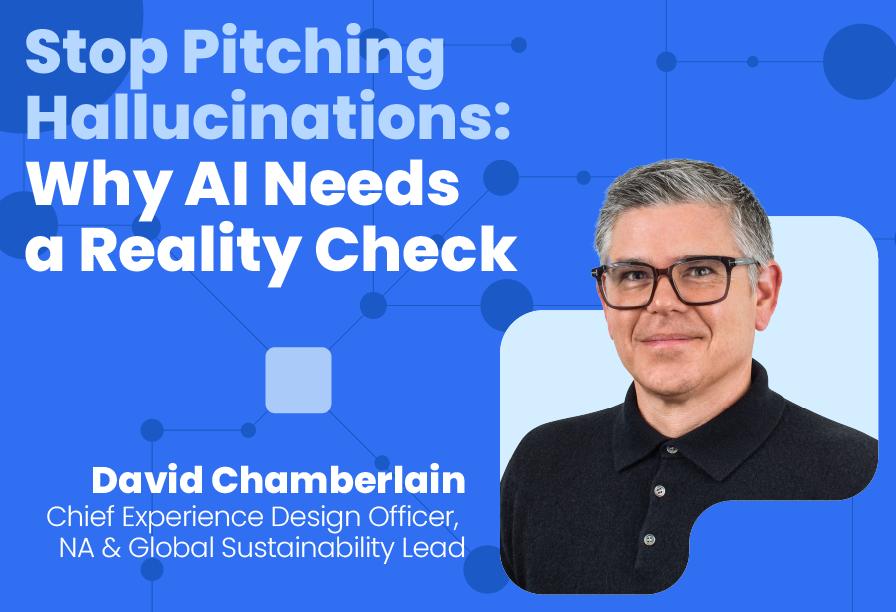
Written by David Chamberlain, Chief Experience Design Officer, NA & Global Sustainability Lead
AI is a high-speed playground for inspiration, allowing us to explore lots of creative directions in a matter of minutes. However, while AI can generate a polished image, it cannot translate those pixels into multi-dimensional real-life experiential activations. Lately, the industry has been seduced by breathtaking renders that ignore feasibility and budget. To keep the human in the loop, we must remember that a prompt is not a plan.
The Human Creative Is the Difference
AI is a remix machine and an amalgamation of existing data. True uniqueness requires a human lens to filter inspiration through taste, culture and purpose. At Momentum, we use Omni AI to supercharge imagination, not replace it. Responsible AI use means every “what if” is immediately tethered to a production-ready “how to.”
The Experiential Reality
AI can create content, but it fails when a concept must become a physical reality. It cannot grasp the human condition. It doesn’t know how long a wait feels in a crowded fan fest, how heat affects a structure at Coachella or the discomfort of a poorly managed crowd. Because AI will never physically attend an event, it cannot design for the people who do.
The Three Pillars of Execution
To turn an aesthetic visual into a successful brand experience, we focus on three things a prompt cannot do:
- Solving for Physics, Not Just Pixels: AI is a master of the cinematic but a novice of gravity. It doesn’t understand the weight of an LED wall or fire permit logistics. We ensure the wow factor is buildable.
- The Budget Reality Check: Treating an AI image as “ready to go” is a fast track to losing client trust. You need a human who understands material costs to ensure the vision fits the investment.
- The Blueprint Over the Prompt: A high-end visual is worthless without an execution strategy. Real expertise, which includes the knowledge of raw materials and the discipline to meet deadlines, cannot be replicated by a machine.
The future of experiential design isn’t AI replacing humans. It’s humans using AI to build authentic experiences. Those experiences that create real connections between people and the brands that matter most to them.